
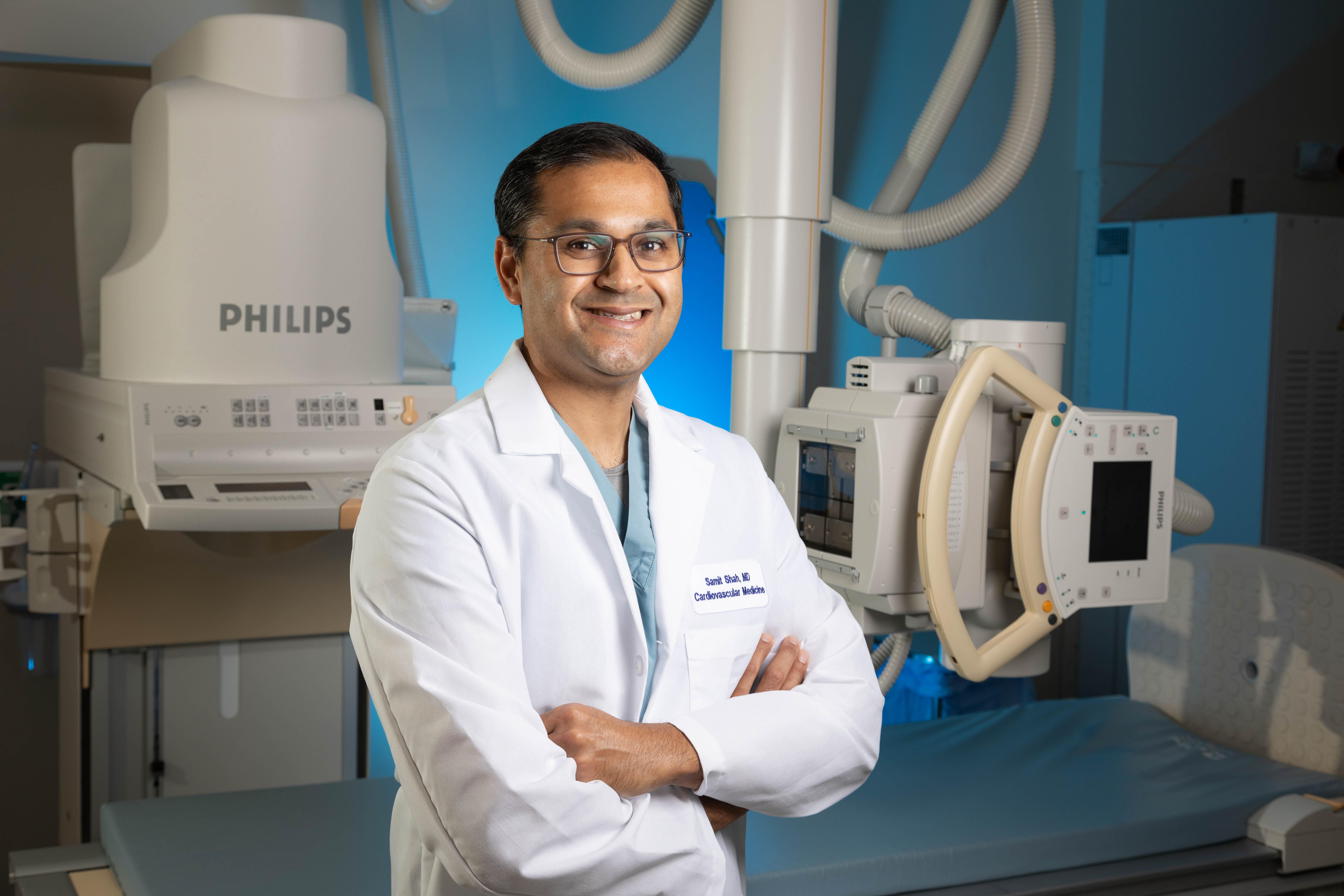
Episode 51: Discover INOCA - Establishing Diagnostic Protocols with Dr. Samit Shah



 RSS Feed
 What if the symptoms of heart disease are present, but the usual suspects aren't to blame? This intriguing question sets the stage for my conversation with Dr. Samit Shah, as we dive into the complex world of ischemia with non-obstructive coronary arteries (INOCA). Dr. Shah shares his groundbreaking work on invasive coronary function testing, a crucial development in the past decade that helps us understand symptoms like chest pain and shortness of breath without coronary blockages. DISCOVER ANOCA program is creating standardized protocols for provocative testing, ensuring that patients receive precise diagnoses and effective care.
Our discussion takes a closer look at the nuanced challenges of diagnosing and treating myocardial bridging, vasospasm, and microvascular dysfunction. With a compelling case study, we illustrate how provocative testing can identify the root causes of symptoms, leading to non-surgical treatment paths. Dr. Shah introduces the Discover Inoka study, which standardizes the use of intravascular imaging for myocardial bridges. By establishing these testing protocols, the medical community is better equipped to treat such conditions with newfound enthusiasm.
As we wrap the conversation, we confront the ongoing challenges and future opportunities in making provocative testing widely accessible. The importance of understanding conditions before major interventions and the role of the Microvascular Network in connecting patients to specialized care are emphasized. We also spotlight advancements in studying myocardial bridging, where surgical unroofing is now tracked in clinical trials, offering unprecedented insights into patient outcomes and enhancing cardiac care. Dr. Shah's insights are driving forward a crucial conversation on improving diagnoses and offering hope to patients with challenging cardiac conditions.
CHAPTER TIMESTAMPS
(00:00) Discover ANOCA Clinical Trial Overview
(08:41) Advance in Diagnosis and Treatment
(14:07) Improving Access to Provocative Testing
(27:24) Myocardial Bridging Clinical Trial Outcomes
Discover INOCA clinical trials application and information is available HERE.
For more information about myocardial bridging and microvascular testing, visit the microvascular network, HERE
White paper on chest pain. American Heart Assoc
https://www.ahajournals.org/doi/10.1161/CIR.0000000000001029
https://www.
https://www.jscai.org/article/S2772-9303(24)01512-6/fulltext
https://www.jscai.org/article/S2772-9303(25)01048-8/fulltext
The enthusiasm for this type of testing is incredible. And so providers around the country reach out. It's really exciting for me as an individual to help teach people and to be part of this. And then you also see a lot of excitement from industry. And I think this is something that's changed a lot since I started doing this is that it's very common to talk about microbascular disease, invasospasm, and myocardial bridging. ENOCA in general has now become a lot more common. And you see this embrace from the medical community. And so I think patients who are afflicted should be excited that there is a lot of attention in terms of development.
SPEAKER_00We'll talk with healthcare professionals, those in related fields that support our condition, and others just like us with stories of their myocardial bridge experiences. It's my intention for this content to inform, educate, entertain, and even motivate or inspire you in your personal journey on dealing with a myocardial bridge. Most importantly is to have you leave each episode with hope, knowing you're not alone and that what you're experiencing is real. Just a quick reminder before we get started that the book is now available at Amazon.com, Imperfect Heart, Stories of Myocardial Bridges. Buy it for anybody who doubts that this condition is symptomatic. My guest this episode is somebody we're very familiar with, is a friend of both the program, many of the doctors we've spoken with, and, of course, many of us, the patients. His research is changing the way myocardial bridges are viewed as well as endothelial dysfunction, vasospasm, and microvascular disease. He's the national co-principal investigator of the Discover ENOCA Multi-Center Registry, better known as Clinical Trial, and a return guest to the program. As an interventional cardiologist, I wanted to have him share the status of the trial, the need and progress in getting a standardized protocol for proper identification of myocardial bridges, endothelial dysfunction, vasospasm, and microvascular disease, and speak generally to the significance of this testing as well as the acceptance of it globally. A pioneer in the field of research and diagnosis, and with expectations of improvement and advancement in patient care, I'm pleased to welcome Dr. Sameet Shaw back to the program. Dr. Sameet Shaw, welcome back to Imperfect Heart.
SPEAKER_01Hi, Jeff. Thanks so much for having me again. It's really a pleasure to be back.
SPEAKER_00And you are our first returning guest, partly because the last time we spoke, we had one of your patients who had been unroofed at Yale. And it was more about the patient than it was about the program. This time around, because we're seeing such significant interest in the causes of the symptoms and recognizing that in every case it may not be the bridge, even though you have a bridge. And you've got the Discover INOCA program, which is a clinical trial. I'd like you to address a little bit here for us. But if you would walk us through the significance of what it is you're doing through these clinical trials, and if you would even explain ENOCA for the benefit of those who are not familiar.
SPEAKER_01Of course. So this concept of patients who have symptoms, chest pain, shortness of breath, fatigue, it's a whole constellation of symptoms in the absence of coronary artery disease or blockages, is what we call ENOCA or ischemia and non-obstructive coronary arteries. And it's a problem where the heart doesn't get enough blood flow, and it can be due to a number of conditions, including coronary microvascular dysfunction, coronary vasospasm, myocardial bridging, and then there's a host of other disorders that are less common but fall under that same umbrella. When patients have ENOCA, it can be harder to diagnose than patients who have coronary artery disease or cholesterol blockages, because all the diagnostic tests that we have are really focused on coronary artery disease, not on ENOCA. And so over the last 10 years or so, a number of centers around the country have been doing invasive coronary function testing or a protocol of testing to actually investigate the heart's blood flow during cardiac atherizations to tease out what is actually going on biologically. The reason we do this is that if we know exactly why a patient has symptoms, we can treat them specifically for what they have rather than just guessing. And I think a number of patients, especially with myocardial bridges, have had to experience this where somebody guesses and says, I'm not sure what's going on. It could be your stomach, it could be something else, and then they get a treatment that may not be the right one for them.
SPEAKER_00We recently had Dr. Jeffrey Folleran from University of Pittsburgh Medical Center did a wonderful job of explaining this interventional, so to speak, catheterization, this provocative test. Would you walk us through a little bit about the association to this provocative test as well as the Discover Enoca program?
SPEAKER_01Yeah, so I'm really happy to hear that. Jeff is a friend and colleague from the University of Pittsburgh Medical Center. And it's one of our success stories in how we've grown this mindset and the technical part of it. And there's centers around the country that are now offering this service to our patients. So I started doing this provocative testing at Yale in 2016, and then it ramped up over time and it's it's become kind of a big referral program over the last eight or nine years. So, what we do during coronary function testing is somebody comes in for a cardiac catheterization. These are usually done on a planned basis because of certain tests that we do. We do a typical heart catheterization where we go in and look directly at the blood vessels. A lot of sensors are increasingly doing this from the radial artery and the wrist, but historically, people would do this from the femoral artery and the leg. And so once we inject contrast eye, we can see the contour of the blood vessels, which is how we look for cholesterol black or myocardial bridges. After that, we then move on and either test for microvascular disease with a wire that's 14,000th of an inch, or test for coronary vasospasm by injecting acetylcholine directly into the blood vessels and looking for endothelial dysfunction or vasospasm. The whole battery test takes a little bit less than an hour. Patients go home the same day. And when we do this, it's incredibly valuable information to the patient because it helps us understand what's going on in that person's body that's explaining their symptoms.
SPEAKER_00In the process of the provocative test, is part of the program's intent to standardize the protocol for the testing so that we know when somebody goes in for what's called a provocative test that they're going to get the testing, the proper testing for vasospasms, for endothelial dysfunction, for microvascular dysfunction, as well as flow relationship to the myocardial bridge. Does every provocative test provide that today as you know it, or is that what part of this Discover ENOCA trial is?
SPEAKER_01Yeah, and we shouldn't have the pretempts that we're taking credit for this. This testing has been around for decades. And there's there's really pioneers, especially with the WIS study, the women's ischemic syndrome evaluation out of Cedar Sinai, um University of Fitz Rigg Medical Center, and University of Florida, that spearheaded this type of testing. And based on that, as technology has evolved, we came up with a standardized protocol. And so this is the protocol that we use at Yale. Our colleagues at Stanford use a very similar protocol. And so in 2020, we developed a research study called Discover and Oca. And so Yale Cardiovascular Research Group is the sponsor. We administer the trial and is funded by Abbott Vascular because they make the Coral Close system that we use to do the wire-based testing.
SPEAKER_00Oh, okay.
SPEAKER_01So Discover Enoca, the whole premise was that we would get centers of excellence around the country to agree on a protocol. And there's some variability within that protocol, but every single patient in Discover Enoca gets a heart catheterization with an angiogram, acetylcholine testing, testing for microvascular disease. And then if a bridge is present, they may get functional testing on the bridge with dobutamine as well. And it's a natural history study. So we do a battery of surveys for every patient or what we call patient reported outcome measures to understand what the patient's symptoms are, how burdened they are by their illness. And then we do that at baseline before they have their functional testing. Then they have their catheterization, and then we follow them for five years. And so we reassess the patients at 30 days, six months, 12 months, and then annually out for five years. And part of the assessment is a call center that's housed at Yale will actually call each patient around the country, follow up on them, and see what's going on. The reason this is important is that as many patients who listen to this podcast know, patients will get care at different medical centers. And it's hard to actually keep track of what's going on with the patient unless you directly engage with them. And so that's why Discover and Oka is centrally based like this. So we can actually understand the natural history of these diseases.
SPEAKER_00After somebody has had their provocative test on the premise that it's done in the protocol that you've worked toward standardizing, there's obviously a lot of different variations in terms of the interpretation of the test. And we are seeing some people who now have been unroofed and continue with symptoms. They become symptomatic post-surgery at some point. And we don't know if it's a year or two years, three years. We see some people now three or four years later, and now they're being diagnosed with microvascular dysfunction or microvascular disease. If that's picked up in the provocative test, how is the determination made that it's not the bridge and maybe it's the microvascular disease or dysfunction? Or how is it determined maybe it's the bridge and it's not the microvascular dysfunction?
SPEAKER_01The short answer is that it's a work in progress. The longer answer is that even over the weekend there was an email exchange amongst a number of us in this field, kind of just discussing definitions and how we describe things like endothelial dysfunction versus coronary basospasm, because people's interpretations may be different and there are some existing criteria, but they're not comprehensive. And so part of Discover and OCA is that we're trying to standardize that language and also come up with definitions that we created when we designed the study and then see how well patients will fit into those. The other thing that's important is to correlate our definitions to symptoms. And so, for example, if we say that a certain diagnosis of a myocardial bridge is significant, it should match the symptoms. We want to make sure that those are the appropriately symptomatic patients, because otherwise the definition in terms of what we find when we're doing measurements doesn't necessarily matter if it's not a symptomatic patient.
SPEAKER_00Oh, that's that's really interesting. If somebody does have a diagnosis of both microvascular dysfunction and myocardial bridge, let's say all three, and vasospasms as a result of endothelial dysfunction, is there any way to identify the primary to secondary to tertiary? Is it going down the list of the significance of each of the maladies, so to speak?
SPEAKER_01Absolutely. And that's why we do this. I can give you a case example of a young woman that I recently cared for, had a diagnostic angiogram, and there was a lot of anxiety about her symptoms because she had a very significant bridge angiographically, had had ongoing symptoms for a few months, and then there was a concern of spasm as well. And so nobody was really sure what to do. She also had some atherosclerosis or plaque. And each time she had symptoms, people weren't were, people weren't sure if this was a heart attack from the atherosclerosis or plaque, if it was the bridge or if it was spasm. And being able to tease out exactly what's going on can be very helpful. And in her case, it was only vasospasm that was causing her symptoms. Her bridge was not hemodynamically significant, and her her blockage wasn't that bad. And having you know cutoff numbers that we can use to actually standardize how we describe these things can help too, because now we can put the patient prognostically into safer buckets and say, well, your cholesterol plaque's not bad and it's in a range where we know you're safe. Your bridge is also not in a range that we would associate it with symptoms related to the bridge. And so that's how in that patient we were able to figure out that the spasm was her primary symptom driver. And sure enough, once we treated that, her chest pain basically resolved.
SPEAKER_00Oh, wow. Without surgery, so she shouldn't have to go through the entire process.
SPEAKER_01If, yeah, I mean, so if she stays the way that she is, she wouldn't. But if she remains symptomatic, then yes, she could potentially consider surgery. But her bridge was not in a range that we would typically recommend unroofing.
SPEAKER_00And so at some point, if she does develop symptoms again, you might go back in, do another catheterization provocative test, identify if the bridge is in fact hemodynamically significant at that point, right?
SPEAKER_01Absolutely. If something changes, then yeah, I think it's reasonable if we if we were no longer able to treat her based on our previous recommendation, we would either try to change the therapy or reconsider provocative testing to see if the bridge changed.
SPEAKER_00Are there instances that you're familiar with where somebody has the bridge as well as microvascular dysfunction? It's determined that the bridge is hemodynamically significant, but it is the microvascular dysfunction. You just skip the unroofing procedure and go straight to treating the MVD.
SPEAKER_01Yeah, and I don't want to reveal too much about interim or preliminary results, but I can tell you so the way Discover ENOCA is designed, we define patients both on the anatomic description of a myocardial bridge, both by, you know, from the angiovam, and then we actually we mandate intravascular imaging. So we either do intravascular ultrasound or optical coherence tomography imaging of all of these vessels. So we will know for certain if there is a bridge present. And this is the first study in this ENOCA population where we're actually imaging all of the blood vessels to say what the natural history is and how frequently we see bridges. So we see bridges in almost 50% of the patients who present to the kap lab with ongoing symptoms that are enrolled in Discover ENOCA. Of that, only about 15% get categorized as having a symptomatic bridge.
SPEAKER_00Interesting. So it's a it's a decent percentage. How many people do you eventually, if I'm not mistaken, is it 500 you would intend it?
SPEAKER_01500, yeah. So we're we're just over 62%. And so 312 enrolled so far, which is it's a great momentum for us and and for our field.
SPEAKER_00Congratulations. I'm excited to hear that. If somebody is in that situation where they have both a hemodynamically significant bridge, there's identification to the microvascular dysfunction. You have to treat both at some point, I would imagine, but you you can't you have to get past the bridge first, correct? Before you can really identify the severity of the microvascular side of things.
SPEAKER_01We can actually stepwise go through and tease out each of these things. And so we use different chemical probes inside of a patient's body. This is the the beauty of doing this, is that we actually replicate human physiology in real time when we're doing this. And so we use acetylcholine to test for coronary basospasm. We use adenosine to bring in the maximal blood flow and test for microvascular disease. And then we use dobutamine as liquid exercise to challenge the bridge. And so we can actually get past each step of this and then identify what the true symptom driver is for our patients.
SPEAKER_00I love liquid because that's it's exactly what it feels like. It's one of the most bizarre feelings ever.
SPEAKER_01Yeah. You don't get the endorphin high, but you get all the bad parts of that.
SPEAKER_00Including the shortness of breath as it's going on. What's the reception been in the medical community at this point in time for what you're doing in terms of the standard is standardization of the protocol for the testing, but even provocative testing in general. What are you seeing as a whole, maybe from comparison to 2016-17 to where we are today?
SPEAKER_01Yeah, the enthusiasm for this type of testing is credible. And so providers around the country reach out. We've had a number of providers from institutions in New England come and visit Yale and learn how to do this. And it's it's really exciting for me as an individual to help teach people and to be part of this. And then you also see a lot of excitement from industry. And I think this is something that's changed a lot since I started doing this, is that it's very common to talk about microbascular disease and vasospasm and myocardial bridging. Enoca in general has now become a lot more common. And you see this embraced from the medical community. People are actually looking at it and looking at new therapies and different diagnostic tests. And so I think patients who are afflicted should be excited that there is a lot of attention in terms of development. I think that the gap here that remains is that adoption overall has a lot of work to do. And I think that's happening slowly. I think centers around the country are picking this up, but I think we still have a ways to go. And then even in centers where this is routinely done, it's usually only one or two individuals in each place who will do this testing. And so the majority of patients who have heart catheterizations and don't have blockages are not going to have provocative testing on their first go-around. So they may need a second catheterization. So I think in the future, ideally, what we would do is use a CAT scan or some other test to understand that before a patient has a catheterization. But our current standard of practice is that patients will often get whisked in for a heart catheterization, often under kind of urgent circumstances. And then as the dust settles, we'll think of doing more testing.
SPEAKER_00Is there a number as you go through the process of the trials, a number of hospitals that's satisfactory? Is it when you hit the 500 patients? Is it let's keep going, let's keep adding hospitals? How do you how do you make that determination?
SPEAKER_01Yeah, Ms. Dover and Oka, we set up, we set it up because we wanted to get centers of excellence or centers that were already doing this testing as a service to our patients. We don't want the study results to reflect a learning curve of the procedure. We want it to reflect the natural history of the disease. So when I sit down with a patient, I can look them in the eye and say, this is what your prognosis looks like based on good quality data. And there is certainly a learning curve with anything that we do. So there's only nine centers enrolling in Discover and Oka. But the goal is to speak a standard language so every center in the country can do this. So any hospital with a cardiac cathodization laboratory should be able to do this. There is no tool that we use outside of the standard things that we have, with the exception of this wire that Abbott Vascular makes. But there's another vendor that should have one to market soon. So I think there's everything is ready for this to scale and to for this to become the standard of care. We're just watching this happen slowly.
SPEAKER_00Boy, that that nothing excites me more than to hear that the people who need the provocative test should be able to get it at some point in the not too distant future. Yeah. And not have to go out of state. And because in some cases they can't, and those are the ones that I feel badly for because they know they're symptomatic, they know they got the bridge, they've got even maybe a surgeon that says I'll take care of it who will take care of it without the provocative test. But we're finding now that surgeons are missing some of the uh constriction from where the heart is is causing an issue hemodynamically. And the provocative test likely would have uh found that. You know, they're they're missing the severity of the vasospasms and or the microvascular dysfunction. And again, the provocative test would have found that. If we could uh focus just for a second on myocardial bridges and look at the uh nature of the provocative test for that bridge. And what I'm really looking for from you, doctor, and I think I I won't have a problem getting it, because you're treating patients and you are performing the surgeries at Yale, the significance of somebody who is going through this process to get the provocative test, find somebody, a center of excellence, that does this provocative test to ensure that they're getting treated properly.
SPEAKER_01Yeah, again, and because of the amazing job that you've done raising awareness and a lot of other things that are out there now, patients have access to a lot of information. So people will get diagnosed with a myocardial bridge, they'll go online, they'll start reading about things. And we see this sometimes where patients will try to jump right to surgical unroofing, and we have surgeons that are willing to certainly discuss it or even proceed with surgery. We advocate that patients get provocative testing so they understand what is going on in their bodies. It's a big surgery to go through only to come out with ongoing symptoms. And so it's in people's best interest that they know what's causing their symptoms. As we know, surgical unroofing, there's a decent likelihood that patients will have symptoms afterwards. So some CRAs will say up to 40% of patients who have unroofing will have persistent symptoms. And a lot of those can be explained by what we would find on the provocative testing. So that's that's the main recommendation for why we want patients to have provocative testing first, is that patients should understand what's going on before they have, you know, a fairly large surgery, which they think is going to relieve their problem completely. And sometimes that's the case, but not always.
SPEAKER_00Do you see you know the hospital system's likely to be able to perform the testing certainly better than I, although maybe at some point we can map that out. In in the United States, do we have enough centers to say that probably within a three state uh circle you might be able to find somebody to do the testing for you?
SPEAKER_01Yeah, so in 2021 or 2022, a consensus group of providers called the microvascular network came together and It's a group of physicians like myself around the country who believe in this and and study this. And it's a scientific entity as much as it's an advocacy entity. And so the microvascular network has a website, the microvascular network.com. There's a a search tool to find a provider who does this type of testing. And then often, and I think a lot of your viewers have experienced this, people will reach out to physicians and we can make a referral to somebody who's local to them. So I think in most cases outside of the true middle of the country, within a three-state area, people were able to find a connection or somebody who can do this type of testing. But we welcome these types of emails. When patients email me, I've responded to as many as I possibly can where I try to get them into the right places. And I'll tell you over the last five years, this has become a lot easier where we have a friend and a colleague, you know, nearby, somebody who so if a patient reaches out to me, I can get them in touch with somebody pretty easily.
SPEAKER_00Well, and I want to compliment you as well, Dr. Shaw. You've been extremely receptive to the people that have reached out because I hear it frequently, either when we speak with them or we see it on the Facebook group. Dr. Shaw responded. He actually responded. And and that's a big deal for somebody who's concerned and fearful and uncertain, just to get that reassurance that I gotcha. Here's what we need to do. Here's the step by step. So thank you for your willingness to support us in that case.
SPEAKER_01Absolutely. It's my pleasure. I I think by no means do I want to be a gatekeeper. And so I totally believe that patients should be able to access information and I'm glad to help.
SPEAKER_00If we have surgeons andor cardiologists who are maybe moving toward a comprehension and an acceptance of the condition as symptomatic, what would you say to them peer-to-peer?
SPEAKER_01Yeah, I think it's a tough question. So peer-to-peer, what I tell people is it's hard to guess what's going on inside of somebody's body. And we don't really guess with anything else that we do. You twist your ankle, we get an x-ray to make sure that it's not sprained or broken. And this is the same thing. If somebody comes in with cardiovascular symptoms, we shouldn't guess and we need to move past that paternalism in medicine where we say, I know best, I know what your symptoms are from. They're not from the bridge. We can actually prove this. And since we live in a world where we have technology, we have access to it, we can figure this out. We should send patients for this type of testing and then help them get on roofing if that's the best treatment for them.
SPEAKER_00I'm gonna ask you a question I didn't have on the list, but it's it's really a precursor to the provocative testing where we know the CT angiogram with contrast is the non-invasive way to best identify whether or not you have a bridge. Is that correct? Correct. Okay. Why is it that more of those aren't done when people present with undiagnosed or misunderstood angina chest pain, shortness of breath, et cetera? Why don't we just start somewhere in the cadence of tests sooner with that?
SPEAKER_01I think it's a cultural change. If you look at the 2021 American College of Cardiology and American Heart Association chest pain guidelines, which tell providers how to evaluate patients with chest pain, a corridor CT angiogram is for almost all patients the first line test. But as our clinical practice will tell, and most patients who are watching, well, no, we still jump to stress testing very often rather than a CT angiogram. And the difference is that a stress test is looking at physiology and looking at symptoms. A CAT scan is looking at anatomy, and a myocardial bridge at the start is a purely anatomic finding. And so we need to describe it with the best anatomic test. So I think this is a change that'll continue to take place over the next five or 10 years where we'll see more and more of these CAT scans being done. And beyond having a good quality CAT scanner, centers don't really need much more than that. And so I think we're going to see the uh you know uptake of this continue.
SPEAKER_00Well, that pleases me to hear because it would identify so much so quickly. And my contention has been all along that while we say it's a very small percentage of people who are symptomatic with bridges, it's only because it's a very small percentage that we know are symptomatic with bridges and or that even bothered to come in and say, I've got a problem, because we live in denial so often, especially when we think it might be something really serious or our heart, and by the time we get there, it may be too late. So this is that's great news to hear. Now I'm gonna get a little personal with you just because what you do is so significant, and I can only imagine the stress levels of dealing with people's hearts and life and death situations. What does Dr. Shaw do for fun? How do you relax?
SPEAKER_01I have two young kids and so and a lovely wife, and so I love spending time with my family. I do a lot of stuff around the house, gardening, things like that. And then I'm a runner, and so I try to get out around 5:45 for a run in the morning before I go to work.
SPEAKER_00That's fantastic. Two young kids is not relaxing.
SPEAKER_01They're agreeing, they're hilarious. It's like having a comedy show at home all the time.
SPEAKER_00Totally agree. I totally agree. I I we have four amongst my wife and I in split in ages. So we we saw each one go through the same process as they all cross that path of threshold, whatever it was, teenagers into college, into you know, careers. So it is it's still comical, by the way. So you've got a lot to look forward to.
SPEAKER_01Yeah, I have a colleague who says small kids, small problems, big kids, big problems.
SPEAKER_00And they just get more expensive.
SPEAKER_01That's right.
SPEAKER_00So let me ask you if anybody's interested in wanting to learn more about the study, doctors or patients, what's the best way for them to go about learning more or finding more or even applying if it's an application process?
SPEAKER_01So all of this is on our website now. So if you go to discoverinoka.com, Inoka is I-N-O-C-A. It's one where you'll find all of this information, including the enrolling sites. We link directly to clinicaltrials.gov where we're registered, and you can actually contact the site investigators. We also have enrollment updates on the website, as well as just some you know basic information about microvascular disease, vasospasm, and myocardial bridging. And so all of that information is there, and it's specifically meant for patients with ENOCA.
SPEAKER_00So you said ENOCA with an I. There is ENOCA with an A. What's the distinction between the two?
SPEAKER_01Not much in terms of just the timing. So ENOCA was first described with an I in 2017. And so ischemia non-obstructive corridors, that's kind of what became the initial language. And then over time, since 2017, we realize that a lot of these patients will not have ischemia on a stress test. And so if we say that you're mandated to have evidence of ischemia, that I then we'll lose a lot of patients. Only actually a handful, about 20%, will have ischemia on a stress test. And so the other term is anoka with an A, angina, in non-obstructive coronary arteries. And so they often refer to the same population, but angina is probably more accurate. But then you could say, well, what if somebody has shortness of breath and they don't have chest pain? Is that still angina? So at some point with any of these terms, we aren't totally inclusive, but now we generally will just say enoka slash anoka. So patients know that they're encompassed in that.
SPEAKER_00One and one and the same, only just a slight difference in the severity of something measurable.
SPEAKER_01Yeah, that's right. Or yeah, whether we see it or not.
SPEAKER_00Got it. Well, Dr. Shaw, I can't thank you enough for your time today. You are certainly a friend to our community, and we sincerely appreciate all that you're doing to help us better identify the situations that we're dealing with. And I want to wish you the best with the testing. I'm so excited to see where we are. I know you're holding back because you know a little bit more about it as as you're seeing some of the results, early results come in. Are we two years into the program now?
SPEAKER_01So, in terms of when we first started enrolling, it was 2022. So almost going on three years in.
SPEAKER_00Oh, excellent. And 300 and some patients at this point, correct?
SPEAKER_01That's right. Yeah. So we actually have follow-up data for a lot of patients already out at one year and some even at two years now. It's really exciting to see this. And actually, in terms of myocardial bridging, we actually amended the protocol. So now we include surgical unroofing as an event. And so we're actually going to be able to track outcomes of surgical unroofing for patients who are in Discover EnochA to see in a standardized way. If somebody has coronary function testing, then they go on for unroofing. We actually track those patients out and can go back and look at the outcome.
SPEAKER_00Oh boy, and that's something we are we the collectively, the group of patients are dealing with now is the consequences of the surgery. You know, are we becoming symptomatic again? I'm I'm thrilled to hear that there's actually a formalized contingent in your trial that's measuring that and keeping an eye on us as we go through. You know, because there really isn't. It's all it's very loosely gathered at this point. And the more we know from a formalized study, it's going to be that much more beneficial for all of us if we go forward into procedures and processes.
SPEAKER_01We're excited to it's the first time in the United States that we've done a multi-center study of myocardial bridging where we capture the results like this of the diagnostic testing and then of interventions. I think it's it's going to be eye-opening for everybody involved.
SPEAKER_00Well, we're here to help. Anything we can do, any messaging we can push, we've got some more product coming out in the next few months that will connect with our listeners, viewers, however they're consuming our product, you know, our content. But congratulations, continued success with Discover Enoca. And I want to thank you from the bottom of my imperfect heart for the work you're doing to help us get a standardized process that we know we can trust and that our surgeons can rely on, and the significance and the value of what that really means. So thank you so much, Dr. Shaw. I really appreciate your time.
SPEAKER_01Jeff, my pleasure. Thanks so much for all the advocacy that you do and for helping so many patients find information.
SPEAKER_00Excellent. Thank you for listening to Imperfect Heart. It's my hope that this information helps in some way to improve your situation or will help you better understand this condition. More importantly, that it gives you hope through stories that there is help and you most certainly are not alone. If you've been diagnosed with a myocardial bridge, please be sure to join the private Facebook group, Myocardial Bridge Support Group. For more information about our program or to reach me directly, visit the website myimperfectheart.com. If you like what you heard today, please give a positive review, thumbs up, high five, whatever your app likes. And be sure to share with everyone important to you so they understand what it is you're dealing with. Please subscribe as well. Welcome each day with gratitude and positivity. Imperfect Heart is a production of Hear Me Now Studio.


